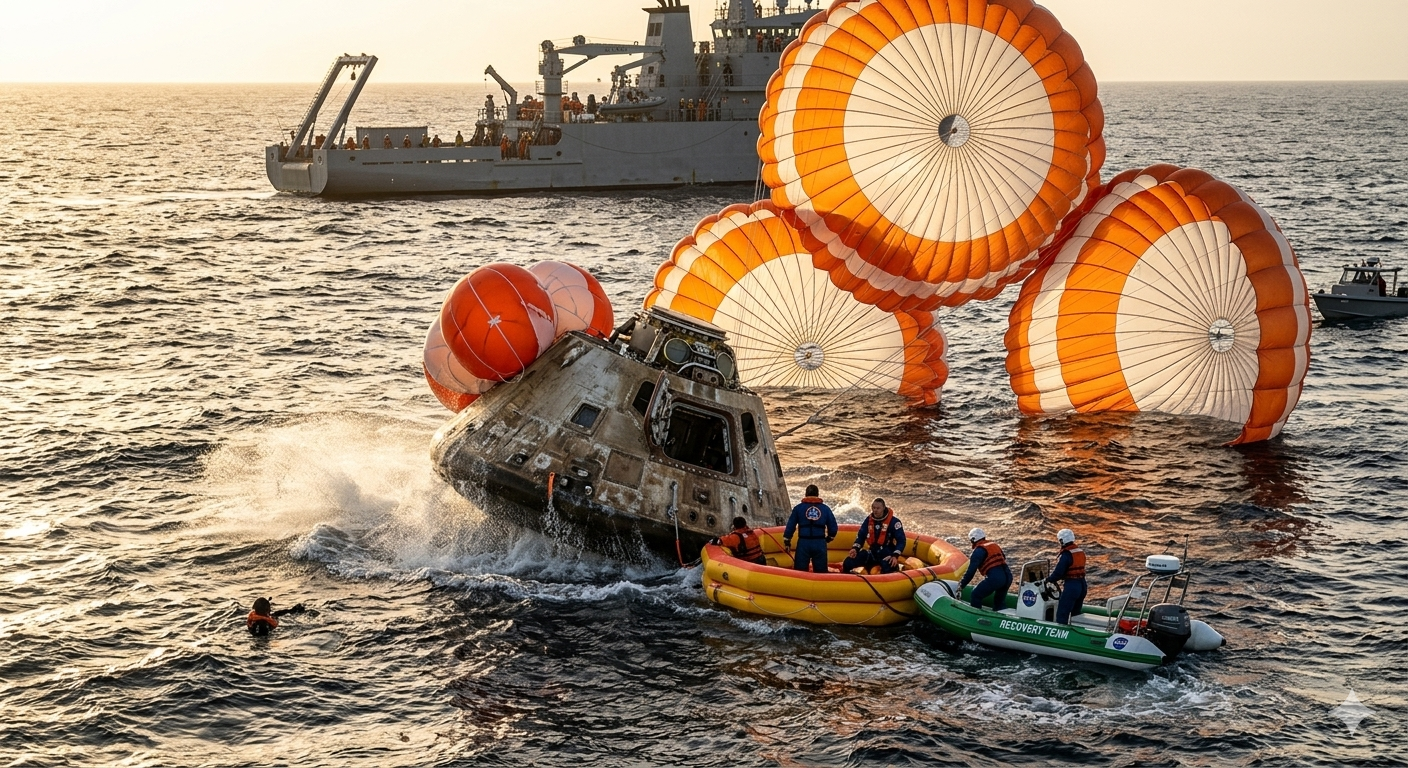
The eyes of the world are currently fixed on the Pacific Ocean as humanity prepares for a historic homecoming. After a breathtaking 10-day journey that took four astronauts farther from Earth than any human in history, the Orion spacecraft is finally making its final descent. For those following the Artemis II splashdown live, the atmosphere is electric, marking the first time in over 50 years that a crewed lunar mission has neared its conclusion.
When is Artemis II Splashdown?
If you are planning your watch party, you need to know exactly when is Artemis II splashdown. The Orion capsule is scheduled to hit the Earth’s atmosphere at approximately 7:53 p.m. EDT (4:53 p.m. PDT) on Friday, April 10, 2026.
Following a high-speed descent, the actual Artemis II splashdown live event is expected to occur at 8:07 p.m. EDT (5:07 p.m. PDT). The spacecraft will land in the Pacific Ocean, specifically off the coast of San Diego, California. Recovery teams aboard the USS John P. Murtha are already in position to retrieve the crew.
Where can I watch Artemis II Splashdown Live?
Check below for Artemis II Splashdown Live
What Happened During the Artemis II Mission?
On April 1, 2026, the Artemis II mission was successfully launched from Kennedy Space Center, carrying Commander Reid Wiseman, Pilot Victor Glover, and Mission Specialists Christina Koch and Jeremy Hansen. The mission was designed to test NASA’s Space Launch System (SLS) and the Orion spacecraft’s ability to support life in deep space.
On April 6, a historic lunar flyby was performed by the crew, swinging just 4,070 miles from the Moon’s surface. During this time, high-resolution imagery was captured, and critical systems were tested to pave the way for future lunar landings. Now, the mission is entering its most dangerous phase: re-entry.
The Trump Statement on Artemis II
As the mission reached its climax, political figures also weighed in. On April 6, 2026, Donald Trump issued a statement praising the astronauts. He referred to the crew as “modern-day pioneers” and expressed that they have “made all America really proud.” Trump took credit for revitalizing the space program during his previous term and invited the crew to the Oval Office upon their safe return. He emphasized that under his vision, America will remain “second to none” in the stars.
US Forest Service Shut Down? The Truth About 57 Facilities Closing and the New 2026 HQ Move
Public Opinion: Reddit and Twitter Reactions
The digital space has been buzzing with excitement and a touch of skepticism. On Twitter (X), the hashtag #ArtemisII has been trending, with fans sharing “streak” sightings as Orion crosses the night sky. Many have praised the diversity of the crew, celebrating Christina Koch and Jeremy Hansen’s historic roles.
Meanwhile, on Reddit‘s r/Space and r/ArtemisProgram, the conversation is more technical. Users have debated whether the mission’s speed will break Apollo-era records. While some “space fatigue” was noted due to previous launch delays, the successful lunar flyby has reignited public confidence. A common sentiment shared by users is: “It doesn’t feel real until you see the parachutes open.”
Conclusion
The successful conclusion of this mission marks a new chapter in the Artemis era. As we watch the Artemis II splashdown live, we are witnessing the bridge between our glorious past and a future where living on the Moon becomes a reality. Stay tuned to the live feeds as the “Integrity” capsule makes its final splash!
For real-time mission telemetry and live views, visit the official NASA Artemis Mission Page.
FAQ: People Also Ask
How can I watch the Artemis II splashdown live?
The event is being broadcast live on NASA+, NASA’s YouTube channel, and even streaming on Netflix as part of a special live programming event.
Who are the astronauts on Artemis II?
The crew consists of NASA astronauts Reid Wiseman, Victor Glover, Christina Koch, and Canadian Space Agency astronaut Jeremy Hansen.
How fast will Orion be traveling during re-entry?
Orion will hit the Earth’s atmosphere at approximately 25,000 mph (40,230 kph), creating temperatures of nearly 5,000 degrees Fahrenheit on its heat shield.
Why is Orion landing in the Pacific Ocean?
The Pacific Ocean off San Diego offers a large, controlled landing zone with calm waters and proximity to U.S. Navy recovery assets.
What is the next mission after Artemis II?
The next phase is Artemis III, which is currently planned to land the first woman and the next man on the lunar surface.
Was the Artemis II mission successful?
As of the current flight data, all mission objectives regarding life support, manual piloting, and lunar navigation have been successfully met.
Read More
- Chris Brown Tour Dates 2026: Usher & Chris Brown Announce Joint “Raymond & Brown” Tour!
- Olivia Millar and Jonah Hill: Secret 2026 Marriage, Baby #2, and the Sarah Brady Controversy
- Michael Patrick in Game of Thrones: Refused Life-Saving Surgery Before His Death After a 3-Year Battle
- Afrika Bambaataa Songs: The Top 10 Tracks That Defined Hip-Hop History
- Who is Elizabeth Olsen Married To? Inside Her Relationship with Robbie Arnett