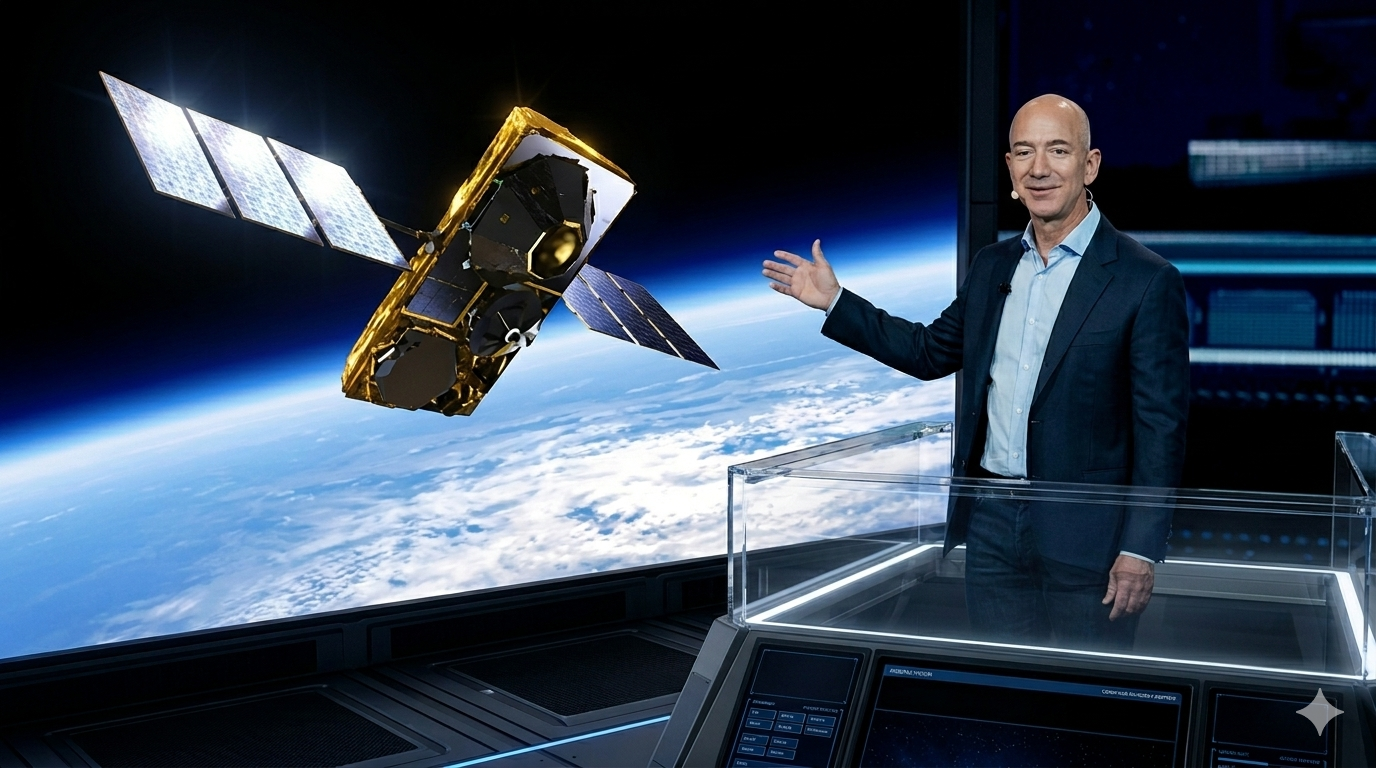
The satellite industry just witnessed a seismic shift that could change how we connect to the internet forever. Globalstar, the satellite communications giant known for its critical partnership with Apple, is reportedly the target of a massive $11.6 billion acquisition by Amazon. This move signifies a major escalation in the “space race” between Jeff Bezos and Elon Musk, as Amazon seeks to bolster its Project Kuiper initiative.
The Explosive Surge of Globalstar stock
Investors and tech enthusiasts were stunned this week as reports surfaced regarding Amazon’s intent to acquire the satellite firm. The news sent the Globalstar stock into a frenzy, with trading volumes hitting record highs as the market reacted to the multi-billion dollar valuation. According to reports from the Financial Times and Bloomberg, Amazon is nearing a deal worth approximately $11.57 billion to integrate the company’s existing Low Earth Orbit (LEO) infrastructure into its own network.
This isn’t just about a simple purchase; it is a strategic maneuver. By acquiring this established player, Amazon bypasses years of regulatory hurdles and technical groundwork. Much like the new channels on Roku expanding digital entertainment, this acquisition expands the horizons of global connectivity.
Key Details: Amazon’s $11.6 Billion Plan for its Amazon satellite network
The core of this deal lies in the Amazon satellite network expansion. Amazon has been developing Project Kuiper to provide high-speed broadband globally, but it has lagged behind SpaceX’s Starlink in terms of active satellites in orbit. By bringing Globalstar under its wing, Amazon gains immediate access to a functional constellation and, more importantly, valuable S-band spectrum rights.
Industry analysts suggest that Jeff Bezos is sparing no expense to ensure Amazon remains a dominant force in the telecommunications sector. This aggressive expansion mirrors the lavish lifestyle often associated with the Amazon founder’s inner circle, such as the luxury lifestyle of Lauren Sanchez. The deal is expected to be finalized within the quarter, pending regulatory approval from the FCC.
Spectrum and Connectivity Benefits
The primary asset driving this price tag is the 2.4 GHz S-band spectrum. This frequency is ideal for mobile satellite services (MSS), allowing smartphones to connect directly to satellites without the need for bulky ground equipment.
Background: How the Apple satellite partner Redefined Connectivity
To understand why this deal is so significant, one must look at the history of the Apple satellite partner. Globalstar rose to mainstream prominence when Apple announced that the iPhone 14 and subsequent models would use their satellites for Emergency SOS features. Apple even invested hundreds of millions into the company’s infrastructure to ensure reliable service.
However, the landscape of tech is often volatile. Just as fans were shocked by the Avatar The Last Airbender movie leaks, the tech world was caught off guard by Amazon’s sudden move to snatch Apple’s key partner. This creates a fascinating dynamic where Amazon could potentially control the infrastructure that powers a flagship Apple feature.
Public Reaction: Investor Frenzy Over GSAT stock and Market Shifts
The reaction on social media and financial forums has been a mix of euphoria and skepticism. On Reddit and Twitter, the discussion around GSAT stock has reached a fever pitch. Retail investors who held the stock through its quieter years are now seeing a massive potential windfall, while others worry about the implications of a “bidding war” between tech titans.
Some users have compared the drama to viral celebrity feuds, such as the Alex Cooper and Alix Earle podcast drama, noting that in the world of big business, alliances are temporary and interests are permanent. The public is particularly curious about how Elon Musk will respond to Amazon gaining such a significant foothold in the LEO satellite space.
Key Facts: Globalstar vs Starlink competitor Analysis
Amazon’s acquisition positions it as a direct and formidable Starlink competitor. While Starlink currently has the lead in terms of total satellites, Amazon’s financial muscle and existing cloud infrastructure (AWS) provide a unique advantage.
- Deal Value: Approximately $11.57 billion to $11.6 billion.
- Current Infrastructure: 24+ Low Earth Orbit satellites currently operational.
- Spectrum Advantage: Ownership of global S-band licenses for mobile-to-satellite communication.
- Apple Relationship: Apple currently utilizes 85% of its network capacity for emergency services.
- Amazon’s Goal: Integrating these assets into Project Kuiper to provide seamless global internet and mobile roaming.
This move is a clear signal that the era of satellite-to-phone connectivity is no longer a niche feature but a standard requirement for the next generation of mobile technology.
Why This Is Trending
The news is trending because it represents one of the largest aerospace acquisitions in recent history. The intersection of Globalstar, Apple, and Amazon creates a “perfect storm” of interest for tech enthusiasts, stock traders, and geopolitical analysts. Furthermore, the rivalry between Jeff Bezos and Elon Musk always guarantees headlines.
Just as the internet obsesses over tragic mysteries like the Ashlee Jenae case or the passing of Dolly Martinez, the business world is captivated by the potential “death” of independent satellite operators as they are swallowed by trillion-dollar tech conglomerates.
What Happens Next
The coming months will be critical for Globalstar. First, the deal must pass rigorous antitrust scrutiny. Regulators will look closely at whether Amazon owning such a large portion of the satellite spectrum creates an unfair advantage.
Second, the relationship with Apple remains a question mark. Will Amazon honor the existing contracts, or will Apple be forced to find a new partner or build its own constellation? This uncertainty is causing some volatility, similar to the controversy surrounding Justin Bieber’s Coachella performance. Regardless of the outcome, the satellite industry will never be the same.
In conclusion, the Globalstar acquisition is a bold play by Amazon to secure its future in the stars. Whether it succeeds in toppling Starlink remains to be seen, but for now, the sky is no longer the limit for Jeff Bezos.
FAQ
Does Apple own 20% of Globalstar?
Apple does not own the company outright, but they have a significant partnership that includes an investment of $450 million from Apple’s Advanced Manufacturing Fund to support the satellite infrastructure used for iPhone features.
What is the current Globalstar stock price prediction?
Following the Amazon acquisition news, analysts have raised their price targets significantly, with some suggesting a premium of 20-30% over current trading levels depending on the final deal terms.
How does Globalstar compare to Starlink?
While Starlink focuses on high-speed consumer broadband via large satellite dishes, its partner focuses more on mobile-to-satellite connectivity and IoT (Internet of Things) tracking, making them complementary but increasingly competitive.
Will my iPhone still have satellite SOS if Amazon buys the company?
It is highly likely that existing contracts will be honored in the short term, though long-term exclusivity may be negotiated between Amazon and Apple.
What does GSAT stand for?
GSAT is the stock ticker symbol for the company on the NYSE American exchange.
Is Amazon buying Globalstar to compete with Elon Musk?
Yes, the acquisition is widely viewed as a strategic move to accelerate Amazon’s Project Kuiper and provide a direct alternative to Musk’s Starlink network.