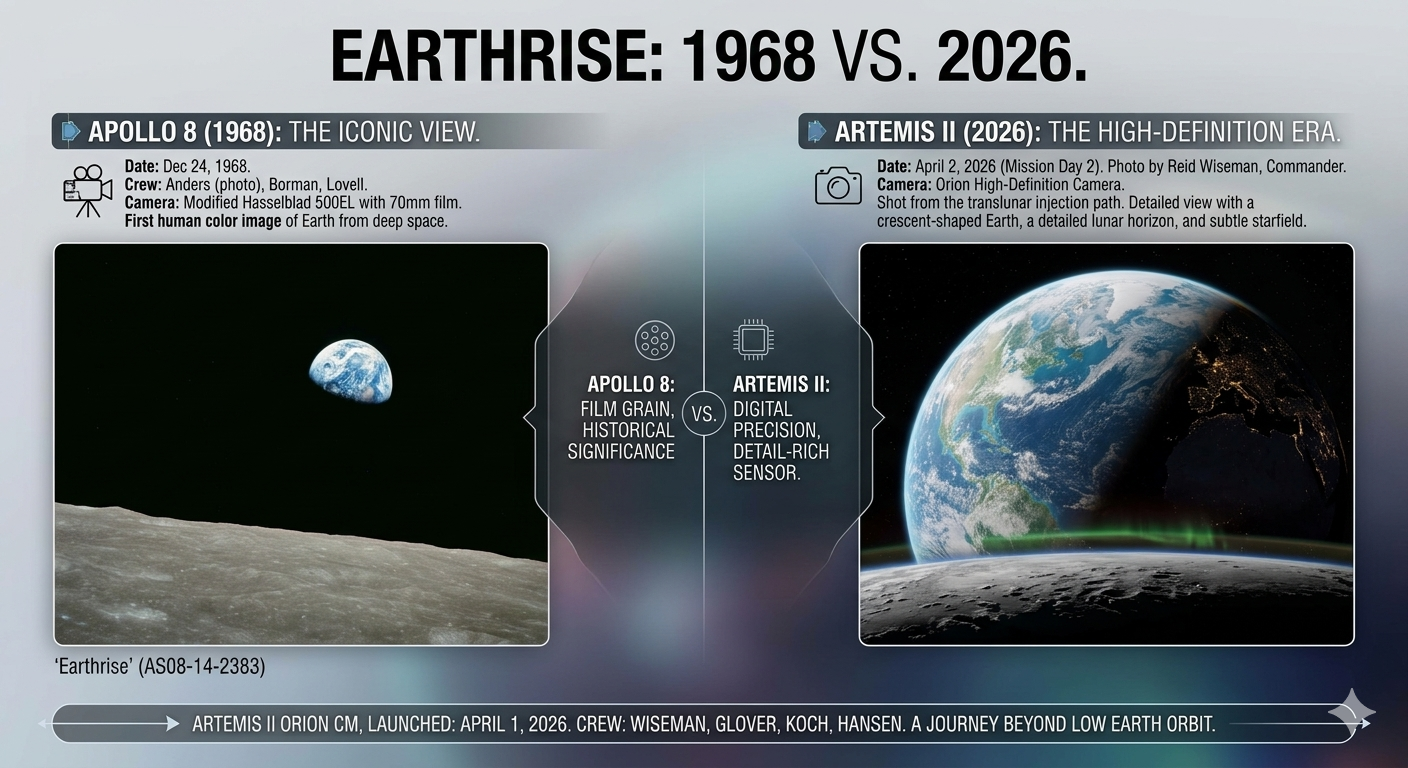
Exactly 54 years after the legendary Apollo missions, humanity is back at the Moon. Today, April 6, 2026, marks Flight Day 6 of NASA’s Artemis II mission, and it is arguably the most critical 24 hours of the entire 10-day journey.
The Orion spacecraft, carrying a crew of four brave astronauts, is currently executing its Lunar Flyby. This isn’t just a routine check; it’s a mission that is breaking records and setting the stage for the next lunar landing. Here is everything you need to know about today’s live updates from deep space.
Breaking the Apollo 13 Record
One of the most emotional moments of the day occurred at 1:56 PM EDT, when the Artemis II crew officially surpassed the record for the farthest humans have ever traveled from Earth. The previous record was set by the crew of Apollo 13 in 1970 (248,655 miles).
Today, Commander Reid Wiseman, Pilot Victor Glover, and Mission Specialists Christina Koch and Jeremy Hansen reached a maximum distance of approximately 252,757 miles from our home planet. As the crew crossed this “invisible line” in space, mission control in Houston shared a moment of silence followed by a brief celebratory message, marking a new era in human exploration.
Artemis II Live Stream: Historic ‘Earthrise’ and Solar Eclipse Visuals from Deep Space
The “Dark Side” Silence: Loss of Signal (LOS)
The most tense part of today’s mission happens at 6:44 PM EDT. As Orion swings around the far side of the Moon, it will pass directly behind the lunar body, cutting off all communication with Earth. This period, known as Loss of Signal (LOS), will last for approximately 40 minutes.
During this time, the astronauts will be completely alone, seeing a part of the Moon that no human eye has seen directly since 1972. They will be just 4,070 miles above the lunar surface at their closest approach (7:02 PM EDT). This is significantly higher than the Apollo orbits (which were around 60 miles), but it allows the crew to capture high-resolution wide-angle photography of the lunar craters and potential landing sites for Artemis III.
Scientific Goals: Solar Eclipse and Lunar Observations
Today isn’t just about flying; it’s about science. The crew began their formal lunar observations at 2:45 PM EDT.
- Lunar Far Side Photography: The astronauts are using advanced handheld cameras to document the rugged, crater-filled terrain of the Moon’s far side.
- The Space Solar Eclipse: In a rare celestial alignment, the crew will observe a solar eclipse from space between 8:35 PM and 9:32 PM EDT. As the Sun passes behind the Moon from Orion’s perspective, the astronauts will study the Sun’s outermost atmosphere—the corona—which is usually invisible due to the Sun’s brightness.
- Meteoroid Monitoring: The crew is also tasked with looking for flashes of light on the dark side of the Moon, which could indicate meteoroid strikes, providing crucial data for future lunar base safety.
Life Onboard: The Orion Suit Test
Before reaching the Moon, the crew completed a successful checkout of the Orion Crew Survival System (OCSS) suits. These are the bright orange “pumpkin suits” designed to keep the astronauts safe during launch, re-entry, and emergency depressurization.
The crew reported that the suits are comfortable and that the internal mobility allows them to perform all necessary cockpit operations. This is a massive win for NASA, as these suits are a significant upgrade over the bulky gear used in previous decades.
Public Reactions: A Global Audience
The world is watching. On social media, the hashtag #ArtemisII is trending globally.
- US Reaction: Across America, classrooms and science centers held “Lunar Flyby” watch parties. The return of US astronauts to the lunar vicinity is being hailed as a “New Moon Race” victory.
- The “Earthrise” Moment: Perhaps the most anticipated moment for the public is the “Earthrise” at 7:25 PM EDT. As Orion emerges from behind the Moon, the crew will see the Earth rise over the lunar horizon, a view that historically changed how humanity views our “pale blue dot.”
Frequently Asked Questions (FAQs)
Q: Why isn’t Artemis II landing on the Moon? A: Artemis II is a crewed flight test designed to verify that Orion’s life-support systems and heat shield work perfectly with humans on board. The actual landing will happen during the Artemis III mission, currently planned for 2027.
Q: How long is the total mission? A: It is a 10-day mission. Having launched on April 1, the crew is expected to splash down in the Pacific Ocean on April 11, 2026.
Q: Can we see the live video of the flyby? A: While there is a delay in high-definition video transmission from deep space, NASA is providing near-real-time photos and audio updates through the NASA TV app and website.
Conclusion: The Path to Artemis III
As Orion begins its “free-return” trajectory—using the Moon’s gravity like a slingshot to head back toward Earth—the success of today’s flyby cannot be overstated. Everything the crew learns today—from how the spacecraft handles lunar gravity to the radiation levels in deep space—is a building block for the first woman and first person of color to walk on the lunar surface next year.
The Artemis II crew has reminded us today that while the Earth is our home, the Moon is our next frontier.
Read More
Urgent: Trump Walter Reed Today, Is Trump at Walter Reed? Fact Check
- Spotify Stock (SPOT) Hits Record Highs in 2026: Why the Streaming Giant is Defying Gravity
- Is the OPEC Divorce Final? Why the UAE is Ghosting the Oil Cartel in 2026!
- Why Did Iran Close the Strait of Hormuz Again? The Truth Behind the Strait of Hormuz Closure 2026
- Huge Legal Win for Trump: Appeals Court Shuts Down Criminal Contempt Probe Over Deportation Flights
- AMZN Stock Explosion: Why Amazon’s $11.6 Billion Globalstar Bet is a Game-Changer for Investors
NASA Official Blog: Artemis II Flight Day 5 & 6